
Key Takeaways
- CNC machining car parts enables unparalleled precision, consistency, and repeatability, vital for manufacturing high-performance automotive components.
- The process supports rapid prototyping, custom car part production, and efficient mass manufacturing, giving automakers flexibility and speed.
- CNC machining accommodates a wide range of materials—including aluminum, steel, titanium, magnesium, and plastics—meeting diverse strength, weight, and design requirements.
- Essential car parts produced with CNC machining include engine components, suspension and steering parts, and custom interior/exterior accessories, ensuring critical performance and safety standards.
- Compared to traditional manufacturing methods, CNC machining offers tighter tolerances, faster production, greater design flexibility, and lower long-term costs for high-volume orders.
- Despite its advantages, CNC machining presents design, material, and machining challenges that require advanced expertise, process control, and equipment to overcome.
CNC machining car parts utilises computer-controlled tools to deliver exceptional precision and consistency in automotive manufacturing. This technology enables rapid prototyping, efficient mass production, and customisation of critical components including engine blocks, suspension parts, and steering assemblies. Modern automotive manufacturers require tolerances within 0.001 inches for optimal performance and safety. Leading precision manufacturers like Yijin Hardware specialise in producing high-quality automotive components from advanced materials including aluminium, steel, and titanium alloys.
What Is CNC Machining for Car Parts?
CNC machining for car parts uses computer numerical control to guide automated tools for shaping materials into precise automotive components. Operators program detailed instructions into CNC machines, which then execute complex cuts and operations to meet demanding tolerances. Factories machine metals like aluminum, steel, or titanium for engine brackets, transmission housings, and suspension arms; plastics like nylon or polycarbonate for knobs and housings; and composites for lightweight structural parts. Automotive production requires consistency and repeatability—qualities built into CNC machining process control.
Yijin Hardware in Homestead, FL machines custom car parts using advanced CNC mills and lathes. Gavin Yi, CEO, ensures quality oversight for every batch. Facilities support rapid prototyping when automakers want to validate new designs or custom one-off builds. CNC machining enables quick changeovers between high-mix, low-volume orders and larger production runs, which optimizes both specialty requests and mainstream automotive parts manufacturing.
Manufacturers like Yijin Hardware process design files for prototypes and mass production runs using CNC automation. Technicians monitor dimensional accuracy, surface finishes, and material performance to guarantee each car part fits industry requirements for safety and durability. CNC machining supports part complexity, including intricate gear shapes, engine add-ons, and detailed mounting features, meeting both standard and custom automotive project needs.
Key Benefits of CNC Machining Car Parts
CNC machining brings measurable advantages to automotive manufacturing. Automated precision and adaptable production make CNC machining essential for quality car part manufacturing.
Precision and Accuracy
CNC machining provides automotive parts with high dimensional accuracy. Most CNC machines hold tolerances within 0.001 inches, critical for parts like engine blocks, transmission gears, and suspension brackets. This precision removes much of the human error that occurs in manual processes, reducing defects and promoting consistent fits in vehicle assemblies. Consistency across batches supports industry standards for quality and functional reliability.
Fast Production and Customization
CNC machining accelerates the output of automotive components through automated processes. Machines operate continuously and benefit from robotic part loading, allowing higher part throughput than manual machining. These systems also enable fast turnaround on custom designs or prototypes since switching programs and setups takes minimal time. Low-volume runs or one-off items, such as specialty brackets or prototype housings, use short lead times that suit modern automotive development cycles.
Material Versatility
CNC machining supports automotive part manufacturing with compatibility across metals and plastics. Automakers use CNC to produce aluminum transmission cases, steel suspension links, and custom plastic housings. The method enables the creation of complex geometries and fine details, which standard machining techniques often can’t achieve. This flexibility allows engineers to optimize part material and shape for strength, weight, and cost considerations.
Popular Car Parts Made Using CNC Machining
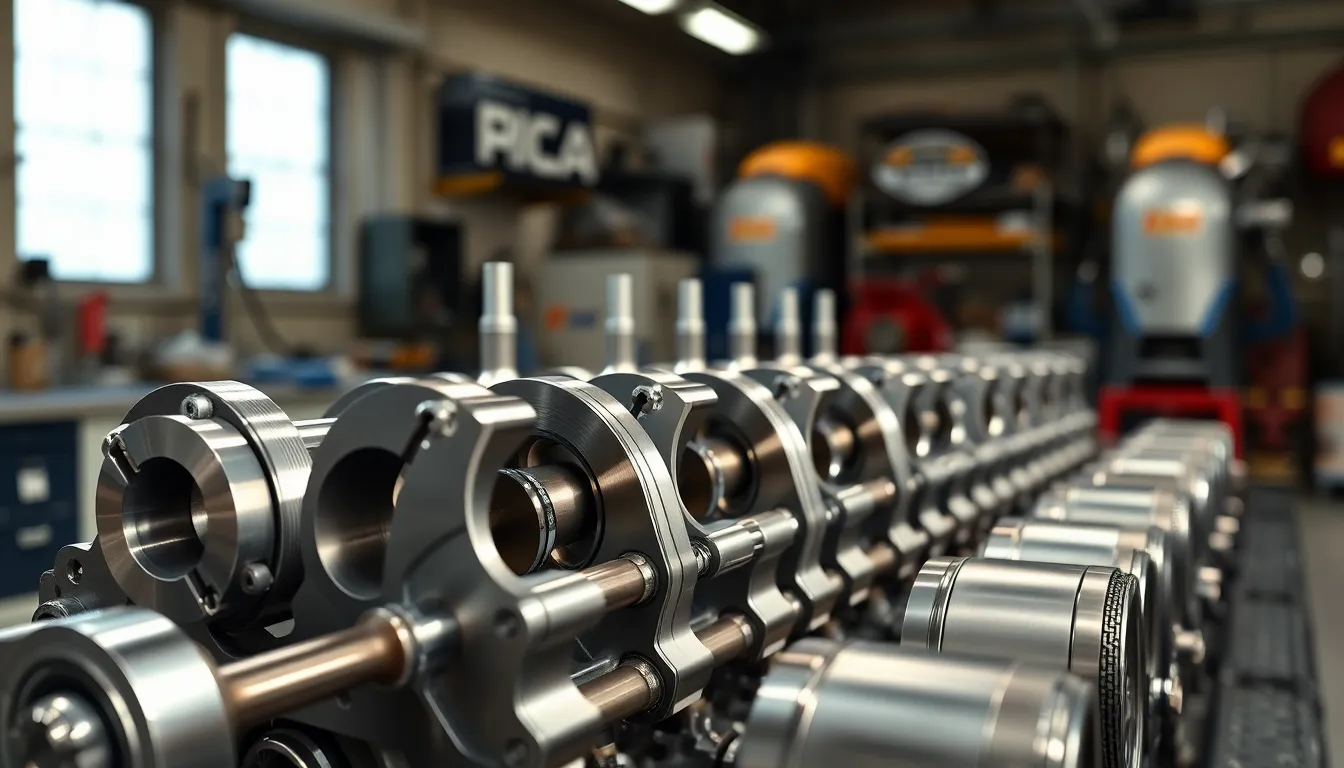
CNC machining produces critical car parts for performance, safety, and quality. Automotive manufacturers rely on this technology for precise, repeatable production across essential assemblies.
Engine Components
CNC machining creates engine components with exact specifications for function and durability. Cylinder blocks and heads, crankshafts, camshafts, pistons, valves, and connecting rods each require tolerances within 0.001 inches for optimum engine performance. Engine blocks and cylinder heads gain highly accurate bores and grooves, supporting combustion efficiency and thermal management. Crankshafts and camshafts produced on CNC lathes and grinders ensure smooth engine timing and power transmission. Pistons machined from high-strength alloys sustain high pressures and temperatures, supporting reliability under dynamic engine loads. Valves and connecting rods receive consistent machining for secure fit and safety. Manufacturers select CNC machining for its ability to achieve consistent repeatability and durability in high-performance engine assemblies.
Suspension and Steering Parts
CNC machining ensures strength and accuracy in suspension and steering parts. Control arms, tie rods, ball joints, steering knuckles, and wheel hubs support vehicle stability and safety, especially under dynamic load changes. Control arms and tie rods demand accurate dimensions for predictable steering and responsive handling. Ball joints and steering knuckles, produced with tight tolerances, absorb road shocks and maintain alignment over time. Wheel hubs machined from robust metals maximize durability and reduce vibration. Consistent quality enables safe operation on highways and racetracks. Manufacturers use CNC machining technology for high-volume suspension and steering parts to achieve high repeatability and cost efficiency.
Custom Interior and Exterior Accessories
CNC machining enables customization of car accessories for both interior and exterior functions. Trim components, brackets, and decorative parts feature complex geometries and unique finishes, produced precisely to client specifications. Trim components, such as dashboard bezels and air vent surrounds, benefit from CNC-machined edges and surface textures, enhancing fit and style. Brackets and mounts manufactured to custom dimensions support electronic modules, lighting assemblies, and infotainment units. Decorative parts, including engraved badges or logo plates, meet strict aesthetic and dimensional requirements. CNC machining supports short-run and mass customization with consistent accuracy, making it the preferred method for unique automotive accessory production.
Comparing CNC Machining to Traditional Manufacturing
CNC machining and traditional manufacturing differ in precision, complexity, efficiency, cost, and application for automotive parts. CNC machining for car parts uses automated, computer-controlled processes to maintain tolerances within 0.001 inches, while traditional methods rely on operator skill, which often results in higher variability. CNC machines with multi-axis capabilities produce intricate features in engine blocks or suspension parts that manual equipment can’t consistently replicate.
Design flexibility increases with CNC machining, as manufacturers change digital CAD models and generate new car components without modifying physical tooling. Traditional techniques limit design changes due to manual adjustments. Production speed rises with CNC because of reduced manual labor and setup, leading to faster cycles for mass-produced automotive parts. Traditional processes suit custom, low-volume, or restoration projects, but slow down when scaling up.
Upfront investment in CNC technology is high, but per-part costs decrease in long production runs by minimizing labor and material waste. Traditional techniques cost less initially, but higher labor costs and slower throughput increase expenses over time. In Homestead, FL, companies like Yijin Hardware use CNC machining for precise and repeatable car part fabrication, supporting the automotive industry’s tight timelines and quality demands. Manual manufacturing remains important when restoration, specialty, or one-off parts are needed. CNC machining dominates scenarios requiring consistency, speed, and complex geometries for automotive production.
Common Materials Used in CNC Machining Car Parts
CNC machining for car parts uses aluminum, magnesium, steel, titanium, and select non-ferrous metals based on specific part requirements. Aluminum, particularly 6061-T6 alloy, provides a lightweight and durable choice for engine blocks, intake manifolds, cylinder heads, and pistons. Manufacturers favor it for its strength-to-weight ratio and standard corrosion resistance.
Magnesium offers even lower weight than aluminum, supporting components where minimal mass is critical, such as racing wheels and connecting rods. Machining magnesium demands strict operational controls due to its reactivity.
Steel supplies high durability for car parts subjected to heavy loads or stress. Factories apply mild steel to structural elements and high-strength alloys to brake rotors, gears, suspension parts, and crankshafts. Steel’s high strength enables precise, reliable performance for critical automotive systems.
Titanium delivers maximum strength, low weight, and corrosion resistance. High-performance and racing applications rely on titanium for essential parts. The material’s complex machining process and higher cost restrict usage to specialized or advanced vehicle components.
Other non-ferrous metals such as brass, copper, and bronze occasionally appear in bespoke parts where unique machinability or conductivity is required. Yijin Hardware in Homestead, FL, consistently machines these materials, tailoring solutions to automotive sector demands for both prototyping and production.
Challenges and Limitations to Consider
CNC machining for car parts faces multiple limitations that impact design, part quality, and manufacturing efficiency.
- Design Constraints: Complex car part geometries, including undercuts and intricate internal features, often can’t be produced due to tool accessibility. Only advanced CAD/CAM software, such as the programs used by Yijin Hardware in Homestead, FL, enables simulation and design optimization before machining.
- Maintaining Tight Tolerances: Automotive components, like transmission gears and pistons, demand high precision. Consistent tolerances within 0.001 inches become difficult to sustain in high-volume runs without frequent machine calibration and top-grade cutting tools.
- Thin Wall Deformation: Thin-walled parts, such as engine covers, may deform or break from machining forces. Modifying cutting parameters or designing additional reinforcement helps reduce this risk.
- Material Machinability Issues: Materials such as titanium alloys or hardened steels wear out cutting tools quickly and slow down cycle times. Selecting specialty tooling, adjusting feed rates, and using optimal coolants help manage these production challenges.
- Tool Geometry Limits: Standard CNC cutting tools with cylindrical shapes leave internal corners with a radius, preventing sharp features or those unreachable from above. Machining deep cavities in components like intake manifolds requires extended tools, which can increase chatter and affect accuracy.
- Size and Weight Boundaries: The work envelope and weight limitations of CNC machines restrict part size. Large components require gantry or bridge mills with greater capacity, like those used for structural chassis parts.
- Assembly and Fit Complexity: High precision in integration with other car systems requires careful measurement and modular design, often increasing the need for post-machining inspection and adjustment.
Yijin Hardware applies advanced simulation, precision calibration, and tailored process optimization to help automotive suppliers mitigate these CNC machining constraints.
About Yijin Hardware
Yijin Hardware, located in Homestead, FL, is a leading provider of precision manufacturing services, specialising in CNC machining, sheet metal fabrication, and custom fasteners.
Under the leadership of CEO Gavin Yi, Yijin Hardware also offers additional solutions such as die casting, injection molding, and 3D printing to support various industries, including automotive, aerospace, medical, and energy. With a commitment to high-quality manufacturing and precision engineering, Yijin Hardware delivers tailored solutions to meet the unique needs of its clients.
Contact:
Gavin Yi, CEO
Phone: +1 626 263 5841
Email: [email protected]
Website: www.yijinsolution.com
Location:
760 NW 10th Ave, Homestead, FL 33030
Frequently Asked Questions
What is CNC machining and how is it used in the automotive industry?
CNC machining uses computer numerical control to automate machining tools, enabling precise shaping of car parts from metals, plastics, and composites. This technology allows automotive manufacturers to produce complex and accurate components like engine parts, suspension elements, and custom accessories.
Why is precision important in automotive CNC machining?
Precision is critical because car parts require exact specifications to ensure safety, performance, and compatibility during assembly. CNC machining delivers tolerances as tight as 0.001 inches, which minimizes errors and produces consistent, high-quality components for modern vehicles.
What are the main benefits of using CNC machining for car parts?
Major benefits include high precision, repeatability, fast prototyping, customization, and efficient mass production. CNC machining reduces defects, lowers per-part costs during large runs, and enables quick adjustments to designs, helping meet the automotive industry’s evolving demands.
Which car parts are commonly made using CNC machining?
CNC machining is essential for producing engine blocks, pistons, crankshafts, transmission gears, suspension parts, steering components, trim pieces, and custom interior or exterior accessories. Its accuracy is vital for both functional and decorative automotive components.
How does CNC machining compare to traditional car part manufacturing?
Unlike traditional methods, CNC machining uses automated processes, ensuring higher precision, fewer errors, and faster production. While initial investment is higher, CNC decreases labor and material waste in large runs. Traditional methods are slower and rely on operator skill, leading to more variability.
What materials are typically used for CNC-machined car parts?
Common materials include aluminum (especially 6061-T6), magnesium, steel, titanium, and non-ferrous metals like brass and copper. Each material is chosen based on its strength, durability, weight, or corrosion resistance needed for specific car parts.
What challenges or limitations exist with automotive CNC machining?
CNC machining can face design constraints with complex geometries, maintaining tight tolerances during high-volume runs, thin wall deformation, and issues with certain material properties. Additionally, machine size, tool geometry, and assembly fit can limit the size and complexity of some parts.
Can CNC machining be used for custom or prototype car parts?
Yes, CNC machining is ideal for rapid prototyping and custom car parts. It allows designers to quickly modify digital models and produce one-off or small-batch components with high accuracy, supporting both innovation and specialized vehicle requirements.
Why do automotive manufacturers prefer CNC machining over manual manufacturing?
CNC machining delivers unparalleled accuracy, consistency, and efficiency, making it ideal for high-volume production and complex designs. Manual manufacturing is generally reserved for unique restorations or specialty parts, as it tends to be slower and less consistent.
Is CNC machining cost-effective for automotive applications?
While CNC machining involves a higher upfront investment, it becomes highly cost-effective in large or repeated production runs due to reduced labor, material waste, and per-part costs. Its ability to quickly switch between designs also saves money for custom or prototype projects.